A time-ordered playbook for new arrivals in Japan: what to do at city hall, how to open electricity, gas, water and internet accounts, and how to avoid the paperwork gaps that cost you later. Written for foreign professionals moving in for work.
Reviewed by: Nobuyuki MoriPresident, M-Assets Co., Ltd. / Licensed Real Estate Transaction Specialist (Miyagi #018212)
When moving, the process of setting up electricity, gas, water, and internet can save you enormous effort if you know the right sequence. From application methods for each utility to important tips during busy seasons, we've compiled the essential knowledge you need for a smooth start to your new life.
Your first week after moving involves concentrated critical tasks—municipal procedures, utility setup, and more. With registration required within 14 days and mandatory attendance for gas activation, this prioritized checklist helps you start your new life smoothly.
Many people are unsure where to start when searching for an apartment to rent. This guide walks you through each step of the process: property search, viewings, applications, screening, contract signing, and moving day.
Moving to a pet-friendly apartment requires different preparation and considerations than a standard move. To help you and your beloved dog or cat start your new life comfortably, this guide brings together practical advice from real estate professionals covering everything from pre-move preparation to post-move rules and strategies for minimizing restoration costs at checkout.
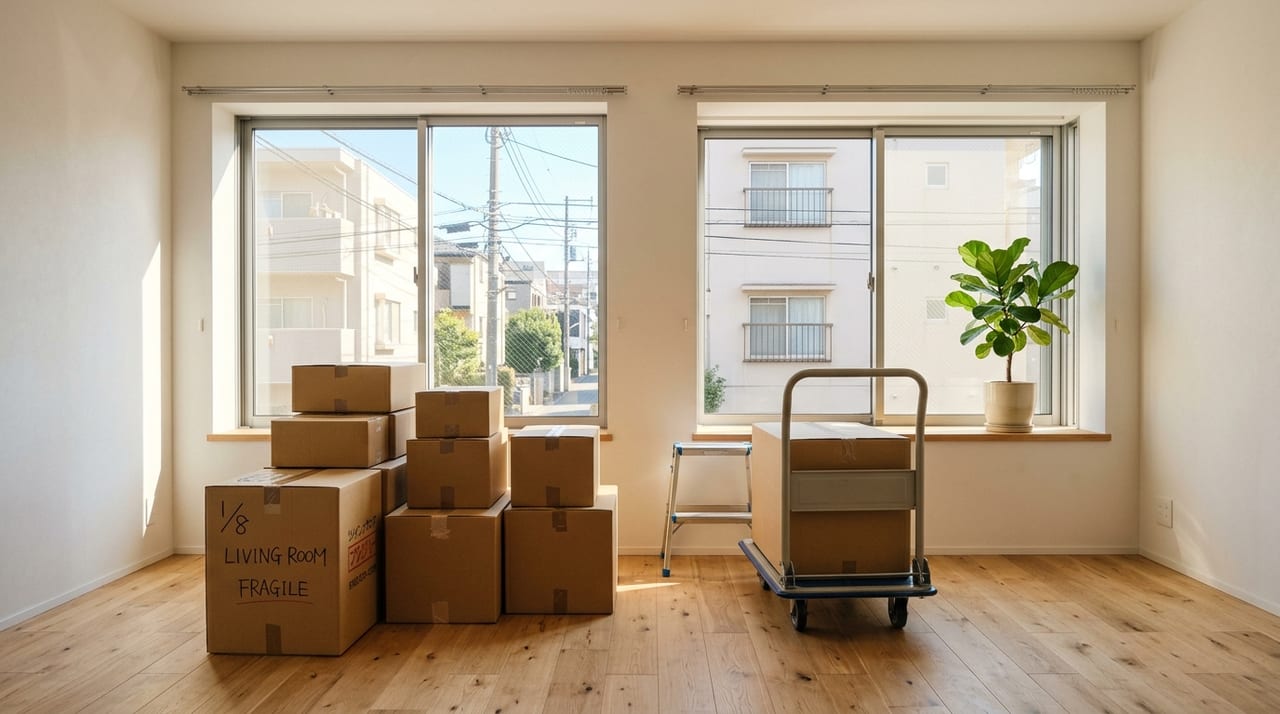
The day you receive the keys to your new Japanese apartment is the day a second wave of paperwork begins. On top of the usual move-in tasks that any resident has to handle, foreign residents have an additional layer: updating the residence card, registering at the municipal office, and securing ID that banks and mobile carriers will actually accept.
This guide lays out the sequence that works in practice — not every step in theory, but the ones that matter and the order you should do them in.
Registering your address at the ward or city office unlocks almost everything else. For mid- and long-term residence card holders, this is done at the local役所 (yakusho) within 14 days of moving in.
Bring
What happens at the counter
Deadline: Within 14 days of moving in. Missing this can expose you to an administrative fine, so treat it as the first errand after you collect the keys.
Ideally you have started these before move-in day. The management company usually hands you a packet with instructions; if they have not, ask.
Japanese fiber internet is rarely instant. Installations take anywhere from two weeks to over a month depending on the building.
If fiber already runs into the building (Flets, collaboration fiber, au Hikari, etc.), you only need a provider contract. Activation can be same-day to two weeks, and an engineer visit is often unnecessary.
If the building has no fiber, you are starting with construction:
Portable Wi-Fi routers with short-term plans are cheap and fast to set up. They cover the gap while you wait for fiber without locking you into a long contract.
Rent and utilities in Japan are almost always paid by direct debit from a Japanese account. In most cases you can only open one after your municipal registration is complete.
Typical documents
Often runs in parallel with the bank account.
Options
Typical documents
Once your municipal registration, bank, and phone are set up, propagate the new address to:
The 14-day rule has teeth. Municipal registration usually triggers the card update automatically, but confirm before you leave the counter that the new address is actually printed on the back.
During peak relocation months (March–April and September–October), gas opening slots book out fast. Schedule the appointment the same day you confirm the move-in date.
If your employer enrolls you in employees' health insurance, you skip National Health Insurance. But if there is a gap before your employer's coverage starts, or if you have dependents not covered by your employer's plan, you may need to enroll in NHI for the gap. Ask at the counter.
Some banks and agencies still prefer a personal seal for account opening and certain forms. Signature-only workflows are increasingly common but not universal. A 100-yen shop or a neighborhood seal shop can cut one in a day.
If your unit has a TV or a tuner-equipped device, you owe an NHK receiving contract. An NHK representative will knock on your door within the first few weeks. Know whether you have a tuner and how you want to respond before they arrive.
If your employer is the leaseholder, some of these tasks shift to the company:
Your personal items — municipal registration, insurance, bank account, mobile plan — remain your responsibility. Coordinate with HR so nothing gets double-contracted.
At the two-week mark, verify:
Japanese apartments run on either city gas (都市ガス, piped) or LPG (プロパンガス, tank-based). Landlords often treat this as an afterthought in the listing, but it has a meaningful effect on your monthly bill. LPG is typically 1.5 to 2 times the per-unit cost of city gas. On a moderate-use household, that's a difference of several thousand yen per month.
Before signing, check the listing or ask the agent directly which type of gas the unit uses. If the building is LPG and your usage will be heavy (daily baths, gas-heated floor, gas dryer), the rent-plus-utilities math can change. You cannot switch gas types yourself — it's a property-level decision — but you can use this information when comparing two similar apartments.
Municipal registration triggers the issuance of your twelve-digit personal number (My Number, マイナンバー). A few practical points for new arrivals:
Do not share your My Number casually. Employers, banks, and health insurance providers have legitimate reasons to ask; almost nobody else does. If a rental agent asks for it during the lease process, decline politely — they do not need it.
Timing is the issue here. You become legally obligated to be covered by some form of health insurance from the moment you register as a resident. There are two tracks:
If you arrive before your job start date — say, you register on April 15 but your employer's coverage begins May 1 — you should enroll in National Health Insurance for the gap. Premiums are prorated by month. When your employer coverage kicks in, you unenroll from NHI.
Forgetting to enroll during the gap can technically result in backdated NHI premiums being charged when you eventually register, even if you never visited a doctor during that window. The simplest approach is to handle both enrollments in one trip to the municipal office.
The Japanese seal (印鑑 or 実印 / 銀行印 depending on context) is no longer strictly required everywhere, but it still shows up in surprising places.
If you decide to get a seal, a simple one with your romanized surname from a 100-yen shop works for routine use. Avoid the ornate 実印 (registered seal) unless you actually need to register real estate or enter into a notarized contract.
The efficient order is: municipal registration, then utilities, then internet, then bank account, then mobile. Start the utility and internet applications before you move in; do municipal registration on your first available weekday after; and give yourself a full two weeks for the slower-moving pieces like bank accounts and fiber installations to land. Keep the 14-day residence card deadline at the top of your list, confirm early whether your building is city gas or LPG, and close the health insurance gap in the same municipal office visit as your initial registration. The rest tends to fall into place.
床スラブ厚と上階の足音問題——賃貸で「ドン」という衝撃音が響く構造的な理由と物件選びのポイント
前橋・群馬の賃貸エリアガイド【2026年版】——主要エリア別家賃相場と住みやすさを徹底比較
Making the Most of Protruding Beams and Columns in Rental Apartments — Smart Furniture Placement Strategies
Mito & Ibaraki Rental Area Guide [2026] — Comprehensive Explanation of Rental Rates and Livability by Major Area
Uncovering Property Issues by Asking Previous Tenants About Their Departure—Questions to Ask During Viewings and How to Interpret Answers
