Complete Guide to the Apartment Rental Process from Search to Move-In — Step-by-Step Breakdown of Viewings, Applications, Screening, and Contracts
Many people are unsure where to start when searching for an apartment to rent. This guide walks you through each step of the process: property search, viewings, applications, screening, contract signing, and moving day.
Renting an apartment involves multiple steps: search, viewings, application, screening, contract, and move-in. For first-time renters and those unfamiliar with the moving process, simply understanding this flow can lead to a much smoother apartment search. This article explains the key points of each step in detail.
Step 1: Clarifying Your Needs and Searching for Properties
The starting point of your apartment search is clarifying what you prioritize. Take time to organize your priorities regarding rent, size, location, walking distance to the station, and amenities (separate bath and toilet, package delivery box, etc.).
While searching on portal sites (SUUMO, HOME'S, athome, etc.) is convenient, you'll sometimes find outdated listings or properties that are already leased (bait-and-switch listings). The key is to use multiple services and contact properties as soon as you find ones you're interested in.
Tips for Organizing Your Needs
•Must-have requirements (e.g., rent under ¥X, within a 10-minute walk from X station) and nice-to-have features should be separated
•Verify your commute or school route on a map and understand actual travel times
•During peak season (January–March), available properties decrease and competition intensifies, so plan ahead with a flexible schedule
Step 2: Consulting with a Real Estate Agent and Booking a Viewing
Once you find a property you're interested in, contact the real estate company (agent) listing it. Most will respond via phone, email, or web form.
The real estate agent's representative will provide detailed information about the property. If you share your preferred area and budget, they may show you unlisted properties as well.
What to Confirm Before Viewing
•Whether the unit is currently vacant (and the move-in date available)
•An estimate of initial costs (security deposit, key money, agency fee, guarantor company fee, fire insurance, etc.)
•Whether special conditions are allowed (pets, musical instruments, etc.)
Viewings are generally free. It's efficient to visit multiple properties on the same day.
Step 3: Key Points to Check During a Viewing
A viewing is both a chance to get a feel for the property and an important opportunity to prevent problems after move-in. Take photos and videos while confirming the following points.
Interior Checklist
•Natural light and sunlight (orientation and impact of surrounding buildings)
•Storage space size and usability
•Condition of wet areas (kitchen, bathroom, toilet)
•Marks, scratches, or stains on walls, floors, and ceilings (may become a liability issue later)
•Outlet location and quantity
•Presence of air conditioning and operational check
Building and Surroundings Checklist
•Cleanliness of common areas (hallways, entrance)
•Noise levels (from roads, train tracks, or neighboring units)
•Location and convenience of bicycle parking and trash area
Golden rule for checking: Ask about anything concerning on the spot. If you contact the agent later, you may be told "we cannot confirm that."
Step 4: Application and Screening
Once you've found a property you like, submit an "application form" to the real estate agent. An application indicates your intent to rent but is not yet a contract. However, the agent will turn away other applicants once you've applied, so apply only after serious consideration.
Documents Required at Application (General Examples)
•ID (driver's license, My Number card, etc.)
•Proof of income (tax withholding certificate, tax return, pay stub, etc.)
•Emergency contact and joint guarantor information (may not be required if using a guarantor company)
Screening is a process to verify the applicant's ability to pay rent and creditworthiness. Generally, an annual income of approximately 30–36 times the monthly rent is the standard benchmark. Screening usually takes 2–5 business days.
What to Do If You're Concerned About Screening
•Prepare income documentation for multiple months
•If you can choose between guarantor companies, select one with more lenient screening
•Register a parent as your emergency contact
Step 5: Disclosure Statement and Contract Signing
After passing screening, the agent will provide a mandatory "disclosure statement" (written by a licensed real estate professional) explaining the property details, contract terms, and special conditions.
Key Points to Confirm in the Disclosure Statement
•Lease term and renewal process (standard or fixed-term lease)
•Security deposit return criteria (restoration to original condition rules)
•Notice period for moving out (typically 1–2 months in advance)
•Prohibited activities (pets, musical instruments, side business use, etc.)
•Presence of appliances and who is responsible for maintenance
Once you're satisfied with the disclosure, sign and seal the lease agreement to finalize the contract. At signing, you'll typically be asked to pay initial costs (security deposit, key money, advance rent, agency fee, guarantor company fee, etc.).
Initial costs typically total 4–6 months' rent. Plan ahead and save for this.
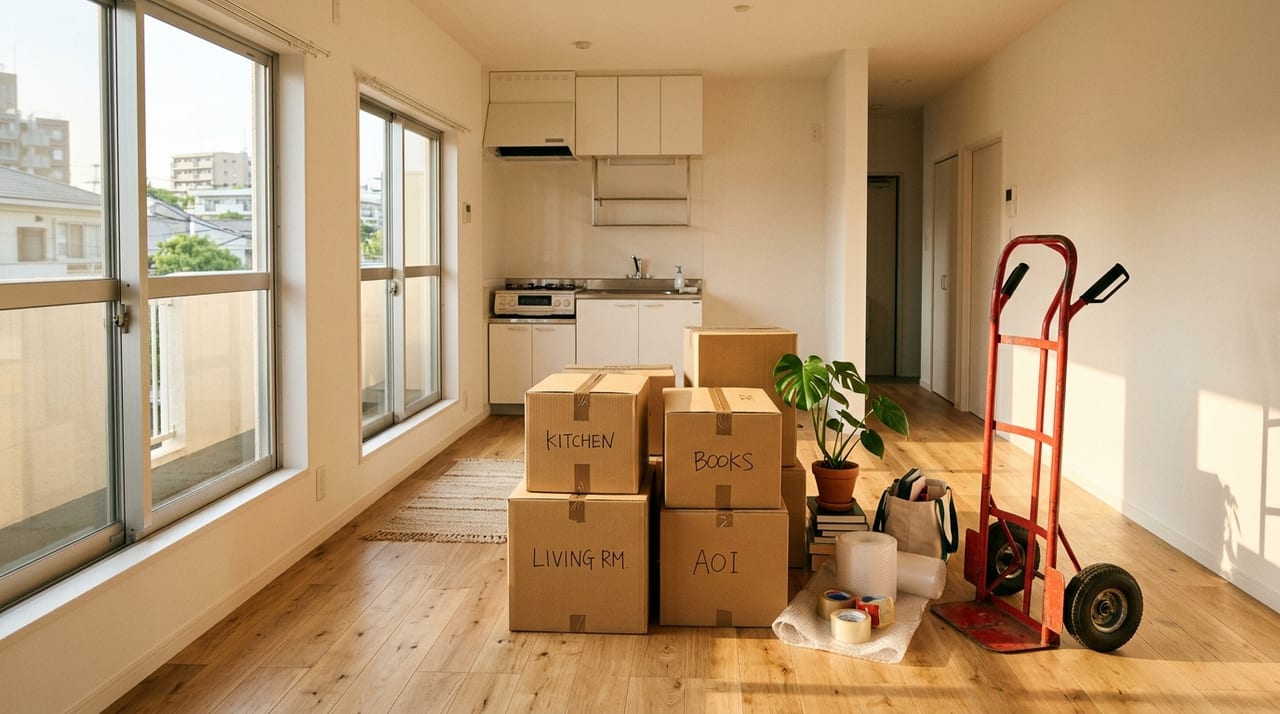
Step 6: Moving Preparation and Move-In
Organize the necessary procedures for the period between signing the contract and moving in (typically 1–4 weeks).
Before Moving
•Arrange a moving company (book early during peak season)
•Arrange for electricity, gas, and water activation (contact in time for your move-in date)
•File a mail forwarding request (available on Japan Post's website)
•Submit a "moving out" notification at your current municipal office
On Moving Day
•Receive keys (from the agent or property management company)
•Document any marks or stains on a pre-move-in inspection form and take photos
•Check meters and be present for electricity and gas activation
Within One Week After Moving In
•Submit a "moving in" notification at your new municipal office (required within 14 days of moving)
•Update your address on your driver's license and My Number card
•Update your address with your bank, credit card companies, insurance providers, etc.
Even when everything goes smoothly, the entire process from apartment search to move-in takes about a month. The key to a stress-free move is to plan ahead and carefully follow through on each step.