For those searching for a rental home to share with a partner for the first time after marriage, we provide a detailed explanation of everything newlyweds need to know—from choosing the right floor plan and budgeting to navigating joint-name contracts.
Reviewed by: Nobuyuki MoriPresident, M-Assets Co., Ltd. / Licensed Real Estate Transaction Specialist (Miyagi #018212)
When you start living together with a partner while already having children, apartment selection requires a different perspective from a typical couple arrangement. This article explains key points for choosing a rental that considers your child's age, school district, and daily routines.
A guide to finding rental properties for couples starting to live together due to cohabitation or marriage. This article covers how to choose between 1LDK, 2DK, and 2LDK layouts, selecting areas that balance both partners' commute access, dividing rental costs, and tips for passing apartment approval reviews.
Essential practical guidance for renting with a partner or roommate: understanding the leaseholder's legal responsibility, fair methods for splitting rent, layout selection tips, and your reporting obligations to the management company.
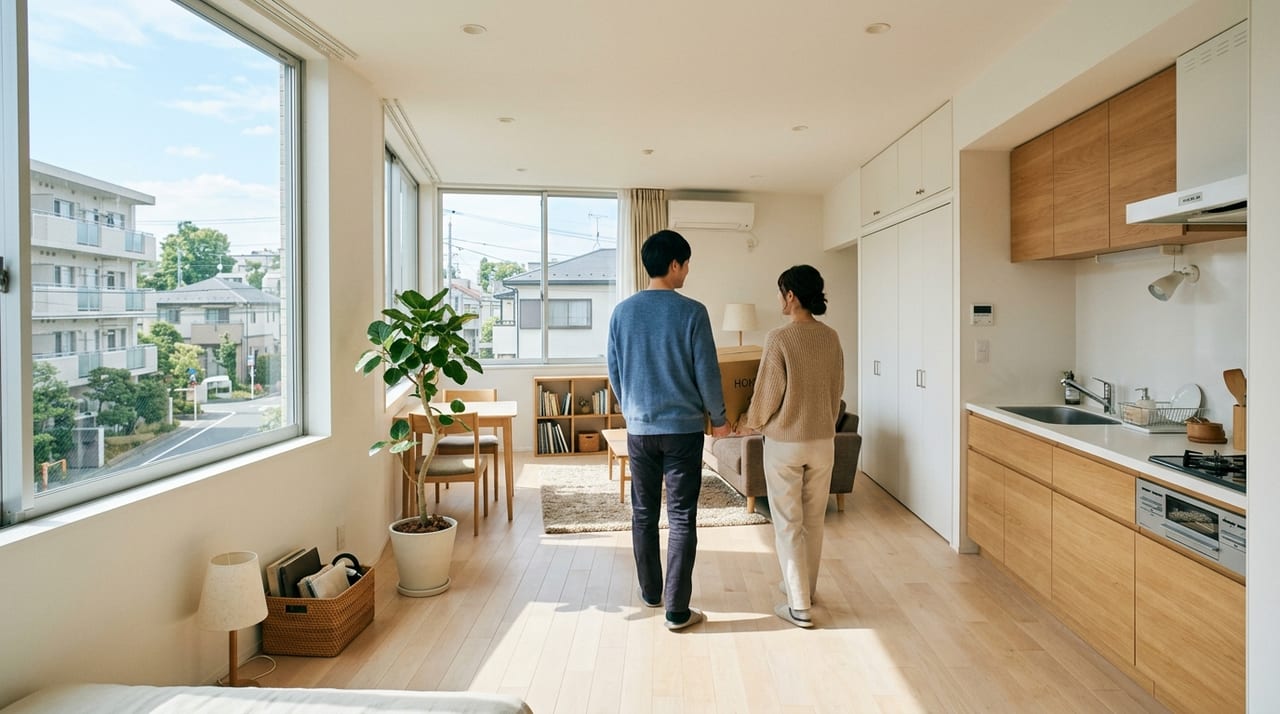
Finding a rental property is an important step when beginning a new life together as a married couple. Even if you've been living alone separately until now, sharing a home requires you to consider many new factors. In this article, we outline the key points and strategies for successfully choosing your first rental home together as newlyweds or partners.
For couples living together, while Japan's Ministry of Land, Infrastructure, Transport and Tourism sets the "minimum habitable area standard" at 25 m² (the same as for single occupants), the following are typical guidelines for couples and married couples:
If either of you works from home frequently or needs personal space for hobbies or work, a 2LDK is worth considering. Conversely, if you prefer to spend as much time together as possible or prioritize cost, many couples find that a 1LDK is sufficient.
Having adequate storage space for both of your clothing and belongings is a critical point to check. During the property viewing, confirm the presence of walk-in closets, closets in each room, and hallway storage. Even if a low-rent property appeals to you, keep in mind that insufficient storage will likely result in additional costs for storage furniture later.
A common guideline for rental costs is to keep rent within 25–30% of your net income. When combining both partners' net income, for example, if your combined monthly take-home is ¥400,000, the recommended rent ceiling would be around ¥100,000–120,000.
However, if one of you plans to take parental or maternity leave after marriage, it's wise to set the rent at a level that allows you to live on one partner's income alone. Planning your budget with future income fluctuations in mind is crucial.
Initial rental costs typically include the following:
In total, expect initial costs to be around 4–6 months' worth of rent. When you factor in moving costs (two people typically have more belongings) and the purchase of furniture and appliances, the initial expenses become quite substantial. It's wise to start saving before the wedding.
Unlike living alone, when sharing a home as a couple, it's important to discuss your lifestyle preferences beforehand.
If you're planning to have children, check the availability and quality of nearby preschools and elementary schools. If you expect to move in 2–3 years, prioritizing lower initial costs is also a sensible choice.
Rental contracts typically come in two forms: "single-name contract" (one partner as the lessee) and "joint-name contract" (both partners listed).
Single-name contracts are more common, with the partner who has higher income or a more stable job typically serving as the primary lessee. The other partner usually acts as a joint guarantor, or the lease may require guarantor company involvement.
Joint-name contracts are not accepted by all real estate agencies or landlords. Even when available, approval may involve more complex screening.
If you sign the lease before marriage, you'll need to declare your partner as a co-resident. Some landlords or property management companies may not accept this arrangement at the engagement stage, so confirm this in advance.
Signing the lease after marriage is often simpler administratively. Since you'll be applying under your new name and address, proceeding with the lease after updating your resident registration and identification documents will streamline paperwork.
Signing the lease as a single occupant with the intention of living as a couple later constitutes a breach of contract and risks eviction if discovered. From the start, apply as a two-person household.
We strongly recommend viewing the property together as a couple. Each person may have different feelings about "livability"—one partner may love it while the other has reservations. Together, check the actual traffic flow and storage capacity, and align your vision for living there.
After the viewing, discuss the following together:
After moving in together, establish rules for how you'll pay rent, utilities, and food costs to avoid future disputes. Using a shared budgeting app to track monthly expenses transparently is also highly effective.
While rent is often auto-deducted from one person's account, when the other partner transfers their share each month, use a bank that offers free transfers (such as transfers between accounts at the same bank or PayPay Bank) to avoid fees.
Starting your first shared home as newlyweds or partners is an important process that begins with property selection. Discuss each other's lifestyle and future plans in advance, and aim to choose a property that balances budget, floor plan, and location well. By confirming details about the contract holder and procedures early on, you can smoothly start your new life together. Take your time to find a property you're both truly satisfied with, so that your shared journey together gets off to a fulfilling start.
不動産ネットワーク
投資物件・賃貸住宅・テナント・運営会社をつなぐ不動産4サイト連携。
A rental housing expert provides a comprehensive breakdown of average utility costs, seasonal fluctuations, and money-saving techniques for couples and married couples living together.
床スラブ厚と上階の足音問題——賃貸で「ドン」という衝撃音が響く構造的な理由と物件選びのポイント
前橋・群馬の賃貸エリアガイド【2026年版】——主要エリア別家賃相場と住みやすさを徹底比較
Making the Most of Protruding Beams and Columns in Rental Apartments — Smart Furniture Placement Strategies
Mito & Ibaraki Rental Area Guide [2026] — Comprehensive Explanation of Rental Rates and Livability by Major Area
Uncovering Property Issues by Asking Previous Tenants About Their Departure—Questions to Ask During Viewings and How to Interpret Answers
