Property listing sheets distributed by real estate agencies contain detailed information not found on rental portals. Master how to read property listings and floor plans, and you'll develop the ability to judge a property's true merits and drawbacks before your showing.
Reviewed by: Nobuyuki MoriPresident, M-Assets Co., Ltd. / Licensed Real Estate Transaction Specialist (Miyagi #018212)
Confirming the reasons previous tenants vacated is an effective way to identify potential problems before moving in. This guide explains how to ask real estate agents, how to interpret their answers, and what the property's true condition reveals.
Off-market properties—those not listed on major portals—often have lower competition and better conditions. This article thoroughly explains the right approach to real estate companies and the mechanisms behind how off-market properties come to exist.
Rental properties that have been vacant for a long time are a sign that landlords are eager to find tenants. Learn how to identify vacancy periods and put them to use in practical rent and condition negotiations.
The most important decision when searching for a rental property is choosing the right real estate agency. We'll explain practical tips to avoid mistakes—from understanding agency fees to identifying reliable agents.
When searching for a rental property, you'll often receive a document from a real estate agency called a "property listing sheet." It's an A4-sized property information sheet packed with floor plans, rent, amenities, and lease conditions. Whether you can read a property listing sheet and floor plan correctly becomes the deciding factor in efficient property selection.
A property listing sheet (recruitment flyer) is a one-page information sheet created by real estate agencies to introduce properties. It's also called a "property overview document" or "recruitment brochure." It often contains more detailed information than what appears on rental portals and is extremely useful as reference material before a showing.
The main information typically included is as follows:
Once you receive a property listing sheet, cross-reference it with information on rental portals to spot any missing details or inconsistencies.
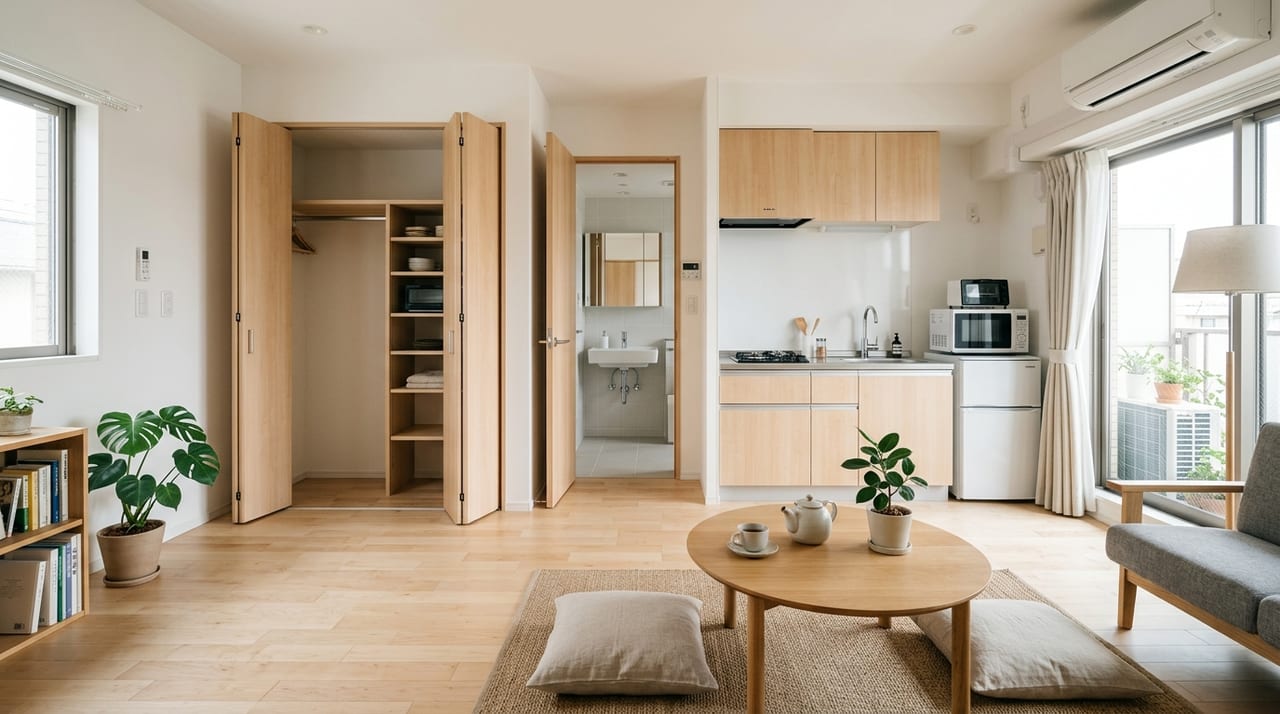
A floor plan is a visual reference that helps you understand a room's shape, size, window placement, and plumbing layout. However, depending on how it's drawn, it may not fully convey how livable it actually is. Read it with the following points in mind.
Even with the same 8-tatami size, a nearly square room and a long, narrow room differ greatly in how you can arrange furniture and how comfortable they feel. Check the room's proportions on the floor plan; be cautious of rooms that are too long and narrow or have irregular shapes.
Windows are shown as lines on the floor plan. Check whether windows face south and if the unit is a corner unit, and see if there are multiple windows. Rooms with only one window tend to have poor ventilation and get hot in summer.
The placement of toilet, bathroom, sink, and kitchen directly affects your daily living flow. You can check on the floor plan whether the toilet and bathroom are combined in one unit or separate. Also verify whether the washing machine location is inside the room and if it's integrated with the sink.
Check for closet (CL) and walk-in closet (WIC) markings on the floor plan. A room with no built-in storage means you'll need to buy storage furniture later, making the room feel cramped. Even living alone, at least one closet is a minimum requirement.
It's helpful to understand the relationship between usable area (square meters) and tatami count. One tatami ≈ 1.62 m² is a useful benchmark. However, apartments often list measurements that include the balcony and wall thickness, so the advertised size may be larger than the actual usable interior dimensions.
Even if it says "Air conditioning included," there's a big difference between having just one unit and having it in all rooms. "BS/CS compatible" just means the reception equipment is installed—it doesn't necessarily mean you can actually watch those channels. Clarify any unclear points during your showing or initial inquiry.
"Pets (by consultation)" and "Pets allowed" are different. "By consultation" means you need landlord approval, which could be denied. The same applies to "Musical instruments (by consultation)" and "SOHO-friendly"—using them without consultation could violate your lease.
Property listing sheets show the conditions for security deposit, key money, and agency fees. You can estimate your initial costs using the formula below.
Estimated Initial Costs = Monthly Rent × (Security Deposit + Key Money + Agency Fee + 1–2 Months' Prepaid Rent)
For example, a property with ¥80,000 rent, one month's security deposit, one month's key money, and one month's agency fee would cost approximately ¥80,000 × 4 = ¥320,000 in initial costs. By calculating beforehand while reviewing the property listing sheet, you can eliminate budget-busting options early.
Property listing sheets are useful resources, but if you take the information at face value, you might make a mistake. Pay special attention to the following points.
When a listing says "7 minutes walk to station," it's calculated using real estate standards: 80 meters of road distance equals 1 minute. This doesn't account for traffic lights, hills, or railway crossings, so the actual time is often longer. For properties you're interested in, check the route on a map app or walk it yourself during your showing.
A 30-year-old building can have a clean interior if it's been fully renovated, while a newer building's condition depends on how the previous tenant treated it. If the listing sheet mentions "renovated" or "refurbished," ask how extensive the work was—whether it included replacing plumbing and fixtures or just surface-level updates like wallpaper.
You might notice "as-is condition" written in small print on the property sheet. This means if the floor plan or equipment description differs from the actual property, the physical property takes precedence. This makes it harder to request corrections if reality doesn't match the listing. For important conditions, it's crucial to verify everything yourself during your showing.
Properties that seem too good to be true—cheaper than market rate with great amenities—may already have applications pending or might just be kept on listings for advertising purposes. When you inquire, ask whether it's still actively available and if any applications have been received. This can save you from wasting time.
Reading listing sheets and floor plans thoroughly before selecting which properties to visit makes your apartment search more efficient. Use the following criteria to narrow down your options:
By pre-screening these factors on the listing sheet alone, you avoid wasting time on disappointments like "it's smaller than I thought" or "the bathroom and toilet are combined." In a limited timeframe, focusing your showings on properties truly worth considering greatly increases your apartment search efficiency.
不動産ネットワーク
投資物件・賃貸住宅・テナント・運営会社をつなぐ不動産4サイト連携。
床スラブ厚と上階の足音問題——賃貸で「ドン」という衝撃音が響く構造的な理由と物件選びのポイント
前橋・群馬の賃貸エリアガイド【2026年版】——主要エリア別家賃相場と住みやすさを徹底比較
Making the Most of Protruding Beams and Columns in Rental Apartments — Smart Furniture Placement Strategies
Mito & Ibaraki Rental Area Guide [2026] — Comprehensive Explanation of Rental Rates and Livability by Major Area
Uncovering Property Issues by Asking Previous Tenants About Their Departure—Questions to Ask During Viewings and How to Interpret Answers
