We'll explain the differences between room sharing and shared houses, balancing both benefits (cost savings, reduced isolation) and drawbacks (privacy issues, lifestyle conflicts, contract risks).
Reviewed by: Nobuyuki MoriPresident, M-Assets Co., Ltd. / Licensed Real Estate Transaction Specialist (Miyagi #018212)
Shared houses, which allow you to live in urban areas while keeping initial costs down, are gaining attention as an alternative to living alone. This guide covers everything you should know before choosing a shared house, from how to select a property to entry screening, common area rules, and common troubles and how to prevent them.
For foreigners searching for housing in Japan, share houses are an attractive option with low upfront costs and easy entry even for those not fluent in Japanese. However, shared living comes with its own rules and cultural differences. This article provides a clear explanation of share house benefits and drawbacks, along with practical tips on how to choose one.
Share houses are expanding from traditional youth-oriented properties to diverse concepts and target markets. This article explains the latest market conditions in 2026, how to choose, and which types of people are suited or not suited to share house living.
If you're considering a shared house in Tokyo, it's crucial to first understand the overall picture of market rates and costs. From rental prices in the 23 wards and outlying areas to the breakdown of initial costs and total cost comparisons with standard rentals, a real estate professional explains the actual conditions.
"Room sharing" and "shared houses" sound similar, but differ in their legal and operational nature. Understanding these differences correctly before choosing is the first step to preventing problems.
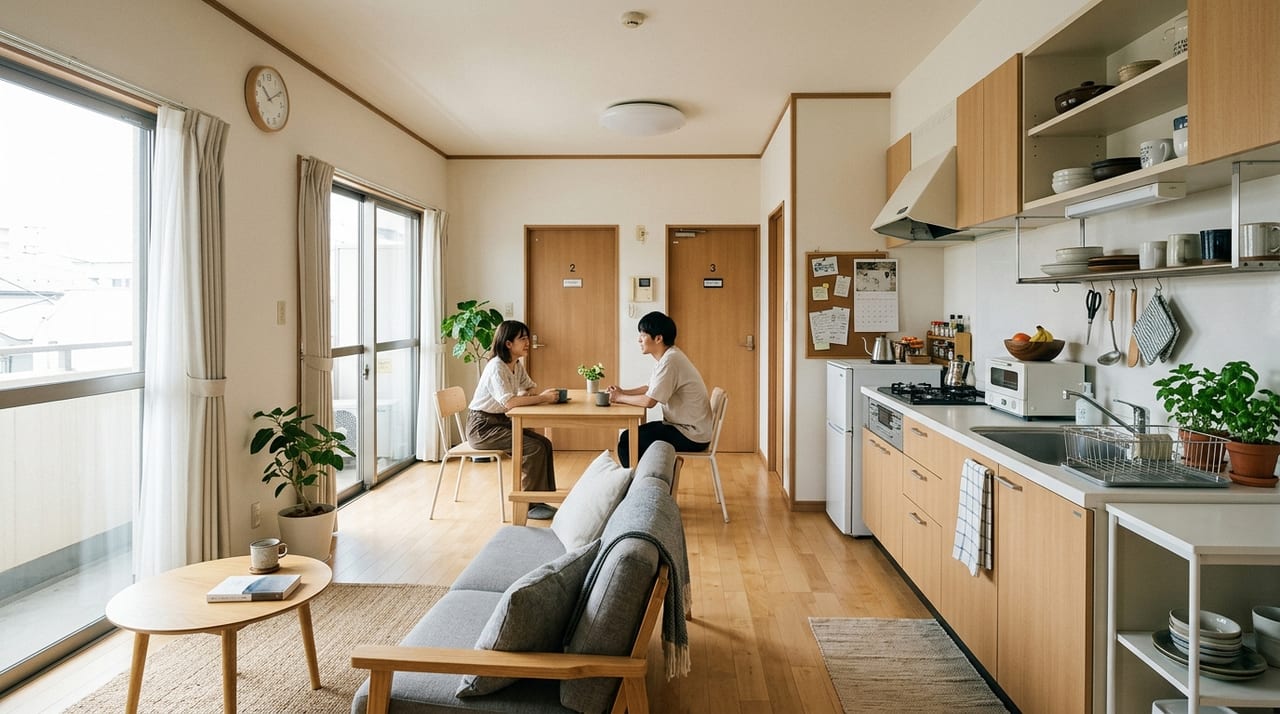
Room sharing is when multiple residents rent a single rental property together, sharing the kitchen, bathroom, and living room while each having a private room. Usually it's an arrangement between individuals (such as friends or acquaintances renting together), with either all residents signing the lease jointly or one representative signing with others splitting costs.
Shared houses are rental properties managed by professional operating companies or landlords designed specifically for multiple residents. Residents typically sign individual contracts with the operating company and rent a private room. Common areas (kitchen, living room, bathroom) are shared by all residents. The key difference from individual room sharing is that the operating company establishes house rules and handles cleaning and facility management.
In this article, we'll treat both room sharing and shared houses together as "shared living" and balance the benefits and drawbacks.
The biggest benefit of shared living is cost reduction.
By dividing rent, utilities, Wi-Fi fees, and shared consumables among residents, you can save significantly compared to living alone in the same area. Even in central Tokyo's 23 wards, many shared houses offer private rooms for ¥40,000–70,000 per month (including common service fees). Comparable solo apartments cost ¥90,000–150,000+ per month, creating savings of ¥30,000–80,000 monthly.
This is a highly practical choice when starting out as a working adult, studying abroad, staying temporarily, or prioritizing savings.
Many people cite "isolation" as a challenge of living alone. In shared living, conversation flows naturally from having others in the same space, ensuring daily communication.
In shared houses especially, the layout naturally encourages residents to meet in common areas, and it's not uncommon for new friendships, professional connections, and cross-industry networking to develop. In international shared houses with foreign residents, some people use them to improve language skills or as a field for cross-cultural exchange.
Many shared houses come furnished and equipped, so you don't need to arrange large items during your move. If common appliances (refrigerator, washing machine, microwave, TV) and living room furniture (table, sofa) are provided, initial costs drop significantly.
This also offers major advantages when combined with temporary assignments, time-limited stays, or nomadic multi-base living — the ability to travel light.
The most common complaint about shared living is privacy.
Even in shared houses with private rooms, someone is always in the common areas. You might find the kitchen occupied when you want to cook, need to wait for a shower, or hear noise from late-night visitors or early-morning routines — friction that doesn't exist in solo living.
Introverted people and those who work from home often feel they have no private space to relax in even after coming home. If privacy is important to you, verify the soundproofing and locking mechanisms of your private room beforehand.
When people with different lifestyles share the same space, conflicts inevitably arise. Common issues include:
Even among friends sharing a room, unexpected personality clashes surface once living together, sometimes damaging friendships.
Solution: Document house rules in advance and secure agreement on cleaning schedules, utility cost splitting, and guest policies. For shared houses, always review the operating company's rule system first.
When friends share a room, contract structure can create problems.
Having one person sign the lease while others split costs is legally unstable compared to joint signatures. If the primary tenant leaves, other residents may lose the right to continue living there. Additionally, some management companies or landlords explicitly prohibit room sharing, and doing so without permission risks eviction for breach of contract.
Solution: Before renting, always confirm with the management company whether multiple-occupancy is permitted. With purpose-built shared houses, this issue typically doesn't arise.
When considering a shared house, always verify these points during viewings and inquiries:
1. Private Room Locks & Soundproofing
Does your private room have a lock? What's the soundproofing level (wall material and thickness)? These are basic privacy essentials.
2. Resident Profile & Gender Mix
Is it mixed-gender or single-gender? What's the age and occupational range? Choosing a house with residents matching your lifestyle reduces conflict.
3. Operating Company Support System
Does the operating company mediate and resolve disputes? Confirm their conflict resolution policy beforehand.
4. Contract Terms (Short-Term Stays & Renewal)
Minimum stay periods may apply. Check whether there's a 6-month or 1-year commitment and what early-exit penalties exist.
5. Reviews from Current Residents
Speaking to current residents during a viewing is most reliable. Also check online reviews and ask the operating company directly.
Shared living is a strong option for people in these situations:
Conversely, solo living suits people who value their own pace and space, or those who work from home and need clear separation between professional and personal time. Choose based on your lifestyle and goals.
Room sharing and shared houses offer major appeal through cost savings, community, and light-traveling lifestyles. However, they also genuinely carry privacy limitations, lifestyle friction, and legal risks.
The key is not to choose purely for cost, but to evaluate against your personality, lifestyle, stay duration, and goals. Thorough pre-move verification and rule-setting are essential for comfortable shared living. As one of many rental housing options, choose what works best for you.
床スラブ厚と上階の足音問題——賃貸で「ドン」という衝撃音が響く構造的な理由と物件選びのポイント
前橋・群馬の賃貸エリアガイド【2026年版】——主要エリア別家賃相場と住みやすさを徹底比較
Making the Most of Protruding Beams and Columns in Rental Apartments — Smart Furniture Placement Strategies
Mito & Ibaraki Rental Area Guide [2026] — Comprehensive Explanation of Rental Rates and Livability by Major Area
Uncovering Property Issues by Asking Previous Tenants About Their Departure—Questions to Ask During Viewings and How to Interpret Answers