Skip to content
SUMUIEスムイエ
PropertiesMoving GuideQuiz
Articles
ColumnsContracts & ProceduresMoving InDaily LifeArea & EnvironmentCosts & FinancesSafety & Disaster Prevention
AboutContact Us
JAEN
SUMUIEスムイエ

Search and compare rental properties across Japan.

Navigation

  • Home
  • Properties
  • Moving Guide
  • Move-in cost calculator
  • About
  • Articles
  • Contact Us
  • FAQ

Member menu

  • My page
  • Member sign-up (free)

Company menu

  • List your properties
  • Company admin
  • Company sign-up (free)

Articles

  • Contracts & Procedures
  • Moving In
  • Daily Life
  • Area & Environment
  • Costs & Finances
  • Safety & Disaster Prevention

About us

  • Company
  • Privacy policy
  • Terms of use

Search by area

HokkaidoTohokuKantoChubuKansaiChugokuShikokuKyushu & Okinawa

Popular prefectures

TokyoKanagawaOsakaAichiFukuokaHokkaidoMiyagiHyogoView all areas →

Sister sites

Shueki JPInvestment properties & yield insightsSenkyakuCommercial & retail tenant brokerage

© 2026 SUMUIE. All rights reserved.

HomePropertiesFavoritesContact Us
  1. Home
  2. Columns
  3. Daily Life
  4. How Sunlight and Natural Light Affect Rental Living—Key Checkpoints for Avoiding Dark Apartments
Daily Life

How Sunlight and Natural Light Affect Rental Living—Key Checkpoints for Avoiding Dark Apartments

2026-05-13

Room brightness directly impacts your mood, health, and electricity bills. This article explains the key factors affecting natural light in rental properties—orientation, surrounding buildings, and window size—and provides practical tips for accurately assessing sunlight during apartment viewings.
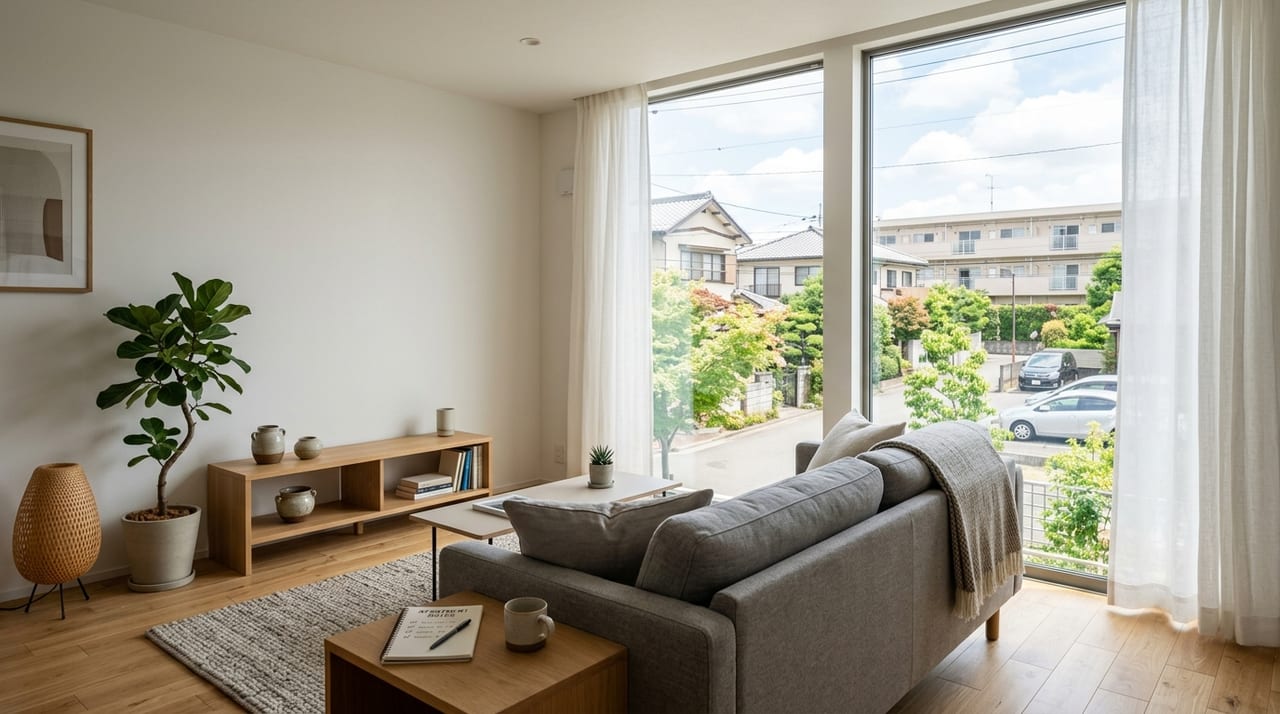
How Sunlight and Natural Light Affect Rental Living—Key Checkpoints for Avoiding Dark Apartments
#Natural Light#Sun Exposure#Bright Room#Property Viewing#Compass Direction
森

Reviewed by: Nobuyuki MoriPresident, M-Assets Co., Ltd. / Licensed Real Estate Transaction Specialist (Miyagi #018212)

Table of contents

  1. 01"It's Darker Than I Thought" Is One of Top 3 Moving Regrets
  2. 02Five Key Factors Affecting Natural Light
  3. 031. Orientation (Balcony and Window Direction)
  4. 042. Distance and Height of Surrounding Buildings
  5. 053. Window Size and Position
  6. 064. Room Depth
  7. 075. Building Spacing and Upper-Floor Overhangs
  8. 08How Insufficient Sunlight Affects Daily Life
  9. 09Mood and Mental Health
Related

Other columns

The Impact of Balcony Size and Orientation on Your Living Experience—A Complete Guide to Often-Overlooked Points in Rental Selection

A balcony's area, orientation, and shape directly affect how quickly laundry dries and influence natural lighting and ventilation. This article provides a detailed explanation of balcony selection criteria—often overlooked by renters—organized by direction and size.

Earthquake Preparedness and Safety for Renters in Japan—A Disaster Preparedness Guide for Foreigners

Japan experiences frequent earthquakes. This guide explains essential disaster preparedness knowledge for foreigners, including earthquake safety measures in rental properties, preparing emergency supplies, and emergency contact and evacuation procedures.

How to Find Pet-Friendly Apartments in Japan: A Pet Care Guide for Foreign Residents

We clearly explain the key points, precautions, and pet care rules for finding pet-friendly rental properties in Japan, written specifically for foreign residents.

Peak and Off-Peak Seasons in Japan's Rental Market—A Guide to Choosing the Right Time to Rent an Apartment at a Better Price

Japan's rental market has "busy times" and "slow times" to find an apartment. By avoiding the peak season when moving, you can gain leverage in rent negotiations or reduce your initial costs. This article explains the key timing strategies that help foreign nationals find housing in Japan more wisely and strategically.

Back to columns
  • 10Sleep Quality
  • 11Mold and Humidity
  • 12Electricity Costs
  • 13Practical Checklist for Accurately Assessing Sunlight During Viewings
  • 14Check 1: Schedule Viewings at the Right Time
  • 15Check 2: Also View on Cloudy or Rainy Days
  • 16Check 3: Confirm the Position of Adjacent Buildings from Outside
  • 17Check 4: Verify How Far Light Reaches Inside
  • 18Check 5: Verify the Placement and Number of Fixtures
  • 19Tips for Brightening Dark Rooms After Moving In
  • 20Natural Light and the Building Standards Act Lighting Requirements
  • 21Summary: Don't Judge Lighting by Orientation Alone
  • "It's Darker Than I Thought" Is One of Top 3 Moving Regrets

    One of the most common complaints about rental apartments is "it seemed brighter in the photos than it actually is." Most property photos are taken on sunny days and don't always accurately reflect real lighting conditions. The brightness of your living space affects your mood, sleep quality, concentration, electricity bills, and even mold growth. This article explains the key factors influencing natural light in rental properties and provides practical methods to accurately assess sunlight during viewings.


    Five Key Factors Affecting Natural Light

    1. Orientation (Balcony and Window Direction)

    This is the most fundamental factor. The general ranking of sunlight exposure is as follows:

    South-facing > East-facing ≈ West-facing > North-facing

    South-facing units enjoy the longest sunshine hours year-round and offer the most consistent natural light. However, "south-facing" does not automatically mean "bright"—surrounding environment plays a significant role, as discussed below.


    2. Distance and Height of Surrounding Buildings

    Even south-facing units can have blocked sunlight if tall buildings stand immediately to the south. Don't rely solely on the "south-facing" label—verify the surrounding building layout.

    Points to Verify

    • •What stands to the south (buildings, roads, vacant land)
    • •The height and distance of those buildings
    • •Whether any future construction is planned in the area (check with your ward office's urban planning department)

    3. Window Size and Position

    Larger windows admit more light from the same orientation. Additionally, floor-to-ceiling windows (reaching from floor to near-ceiling) provide more light than waist-high windows and brighten the entire room.

    Even north-facing rooms can receive consistent natural light if they have a skylight.


    4. Room Depth

    Even with the same window size, deeper rooms tend to have darker areas at the back where light cannot reach. Light typically reaches about 2 to 2.5 times the window height into the room as a general guideline.

    In deeper 1LDK or 2DK layouts, even if light enters through a living room window, the bedroom in the back may remain dark.


    5. Building Spacing and Upper-Floor Overhangs

    In apartment buildings, upper-floor balcony overhangs can block sunlight. Additionally, when buildings are close together, even south-facing units may only receive sun during limited hours in the morning or afternoon.

    During viewings, look up at the sky and imagine which times of day sunlight reaches the windows.


    How Insufficient Sunlight Affects Daily Life

    Mood and Mental Health

    Insufficient natural light can affect serotonin production, leading to mood swings and reduced motivation. Seasonal affective disorder (SAD), also known as "winter depression," is partly caused by lack of sunlight. With more people working from home, good natural lighting indoors has become increasingly important.

    Sleep Quality

    Exposure to natural light in the morning resets your body clock, promoting better sleep at night. In north-facing or poorly-lit rooms, limited morning light can disrupt your sleep rhythm.

    Mold and Humidity

    Rooms with limited sunlight struggle to dry out, creating an environment favorable to mold growth. In north-facing units or those surrounded by tall buildings, mold prevention is especially important during the rainy season through autumn.

    Electricity Costs

    Dark interiors require artificial lighting even during the day, increasing electricity bills. Well-lit apartments offer the economic benefit of reduced daytime lighting costs.


    Practical Checklist for Accurately Assessing Sunlight During Viewings

    Check 1: Schedule Viewings at the Right Time

    To accurately assess a property's natural light, the most important thing is to view it during times close to when you'll actually be home.

    • •Early risers: View between 9:00–10:00 AM
    • •Those home during the day: View between 11:00 AM–2:00 PM (when the sun is highest)
    • •Night owls or late arrivals: Also check lighting between 5:00–6:00 PM

    Check 2: Also View on Cloudy or Rainy Days

    Sunny-day viewings appear bright and sparkling, but in reality you'll experience many cloudy days. If possible, visit on a cloudy or rainy day to better understand the "minimum brightness" you'll actually live with.


    Check 3: Confirm the Position of Adjacent Buildings from Outside

    During your viewing, step outside the building and verify the following:

    • •Whether buildings stand to the south, and if so, how many stories
    • •The distance between this building and neighboring structures
    • •Whether tall buildings might be constructed at this site in the future

    Google Maps Street View and aerial photos are useful for preliminary research.


    Check 4: Verify How Far Light Reaches Inside

    During your viewing, don't just check near the window—stand in the back of the room to assess brightness there. In layouts where the living room and bedroom are separate, it's especially important to verify the bedroom's lighting separately.


    Check 5: Verify the Placement and Number of Fixtures

    Even in poorly-lit rooms, adequate fixtures placed strategically can minimize lifestyle issues. Besides ceiling lights, check whether there's space for indirect lighting or floor lamps.


    Tips for Brightening Dark Rooms After Moving In

    Even rooms with limited natural light can be made more comfortable with some effort.

    Use Reflection and Diffusion

    • •Choose white or light beige curtains (avoid blackout types)
    • •Select light-colored wallpaper and flooring
    • •Place mirrors opposite windows to reflect light

    Use Strategic Lighting

    • •Choose daylight-temperature bulbs (6000K or higher) for natural-looking brightness
    • •Install multiple light sources to eliminate shadows
    • •Use LED panel lights (ceiling-mounted) to evenly illuminate the entire room

    Improve Atmosphere with Plants and Decor

    • •Add low-light houseplants like pothos or peace lily
    • •Use bright-colored rugs and cushions to create visual brightness

    Natural Light and the Building Standards Act Lighting Requirements

    Japan's Building Standards Act requires that living spaces have minimum natural lighting areas. Residential rooms must have windows that provide at least 1/7 of the floor area in usable light.

    However, this is only the legal minimum—it doesn't guarantee comfortable lighting. Many properties that meet the standard can still feel dark, making in-person viewings essential.


    Summary: Don't Judge Lighting by Orientation Alone

    Rental property lighting isn't determined by orientation alone. It's crucial to evaluate all factors comprehensively: surrounding building heights and distances, window size and position, room depth, and viewing time of day.

    If you want a bright living space, be sure to view properties multiple times at different hours and check the surrounding environment from outside before making your choice. Apartments with good natural light offer benefits that extend to quality of life, health, and savings on utilities.

    Related Columns

    • 収益JP

      不動産投資家のためのAIツール

      投資判断を支援するAI活用

    • 収益JP

      2026年金利戦略

      不動産投資家向けの金利動向と戦略

    • 収益JP

      仙台不動産市場の2026年課題

      仙台エリアの投資マーケット分析

    Categories

    • Contracts & Procedures215
    • Moving In129
    • Daily Life288
    • Area & Environment111
    • Costs & Finances118
    • Safety & Disaster Prevention72

    Popular tags

    #Move-out Restoration85#Property Selection70#Solo Living67#Average Rent

    Smart Locks & IoT Equipment Transforming Rental Living——How to Use Latest Features & Key Precautions

    As smart locks and IoT appliances spread throughout the rental market, real estate professionals explain how the latest convenient equipment works, its benefits and drawbacks, and important precautions when adopting it.

    Smart Apartment Search Online — How to Use Property Portals and Gather Information Before Viewings

    From setting search criteria on portal sites to gathering information that photos alone cannot reveal. We explain the know-how for efficiently conducting your apartment search online.

    Sister sites

    Shueki JP

    Investment properties & yield insights

    Senkyaku

    Commercial & retail tenant brokerage

    62
    #Foreigners60
    #Rental Contracts59
    #Initial Costs51
    #Property Viewing50
    #Rentals47
    #Guarantor Company36
    #Area Selection36
    #Tenant Screening36
    #Cost Savings32
    #Moving31
    #Property Management31
    #Move-Out Costs30

    Columns

    • 床スラブ厚と上階の足音問題——賃貸で「ドン」という衝撃音が響く構造的な理由と物件選びのポイント

    • 前橋・群馬の賃貸エリアガイド【2026年版】——主要エリア別家賃相場と住みやすさを徹底比較

    • Making the Most of Protruding Beams and Columns in Rental Apartments — Smart Furniture Placement Strategies

    • Mito & Ibaraki Rental Area Guide [2026] — Comprehensive Explanation of Rental Rates and Livability by Major Area

    • Uncovering Property Issues by Asking Previous Tenants About Their Departure—Questions to Ask During Viewings and How to Interpret Answers

    Next article

    Lock Replacement Costs for Rental Housing and Move-In Checklist—Can You Upgrade to Smart Locks or High-Security Keys? →

    Previous article

    ← Adding Smart Locks and Video Doorbells to Rental Properties — Permission Process and Recommended Equipment