Urban or Suburban: 2026 Area Selection by Lifestyle
As remote work becomes established in 2026, choosing a rental area is increasingly influenced by personal values. We explore the latest conditions in urban and suburban areas, and outline selection strategies by lifestyle.
Japan's work culture has changed significantly since the pandemic. By 2026, a hybrid model combining 1–3 days of office attendance per week with remote work has become the norm, while daily commuting by crowded train is now limited to certain professions. This shift has fundamentally altered perspectives on choosing a rental area.
Those who once demanded "30 minutes or less commute time" are now shifting toward "prioritizing home space and environment over commute time." According to the Ministry of Land, Infrastructure, Transport and Tourism's Housing Market Trend Survey (FY2025), for the first time, "room size and layout" surpassed "convenience for commuting and school" as the top priority when renters select their homes. As a result, choosing between urban and suburban areas is no longer a simple comparison of convenience, but a complex decision reflecting individual lifestyle and values.
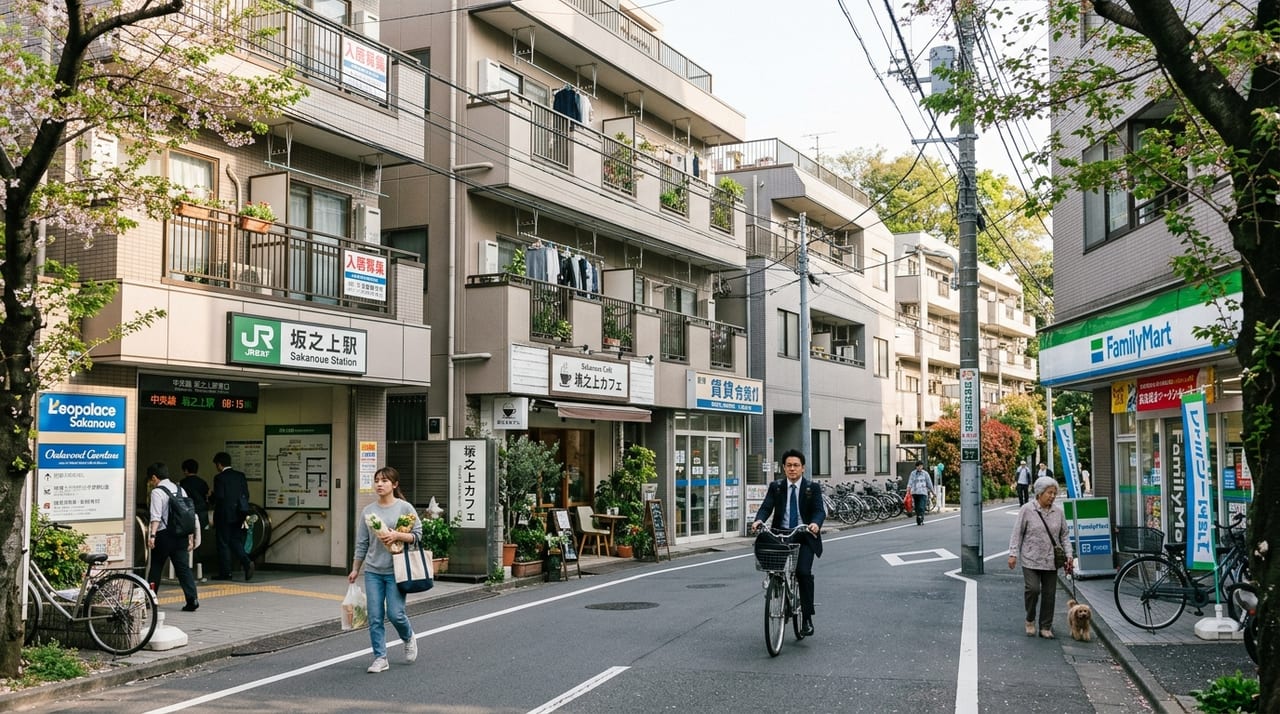
Rental housing in urban areas (Tokyo's 23 wards, central Osaka, central Nagoya, etc.) remains highly popular. The greatest appeal is "overwhelmingly high daily convenience." Properties within a 5-minute walk to stations are abundant, and convenience stores, supermarkets, restaurants, clinics, and municipal offices are all within walking distance. Many shops operate late into the night, making the environment accommodating for those with irregular schedules. Additionally, even if you change jobs or work locations, having access to multiple train lines often means you won't need to move—a hidden advantage of urban living.
On the downside, there's "high rent" and "limited living space." In suburban areas, the same rent might get you a 60㎡ 2-bedroom apartment, but in urban centers, a 25㎡ studio is often the limit. In central Tokyo in 2026, average studio rents have reached 90,000 yen per month, and 2-bedroom family units commonly exceed 200,000–250,000 yen monthly. Environmental challenges such as noise, proximity to neighboring units, and summer heat island effects cannot be ignored. For those working from home, the stress of working all day in a cramped space is surprisingly burdensome. It's common for a desk, chair, and monitor to occupy a third of the room, making it difficult to "spatially separate work and personal life"—arguably the biggest challenge of compact urban properties.
Appeal and Considerations of Suburban Areas
Suburban areas (30–60 minutes by train from central Tokyo) are prime examples of areas re-evaluated since the pandemic. You can rent a spacious apartment at the same price, and easily find properties in green, quiet neighborhoods with parking. For families, remote workers, and those wishing to live with pets, suburban value has increased dramatically.
Looking at concrete figures, in southern Saitama (Kawagoe, Wako, and Asaka areas) and Tokyo, 2-bedroom apartments of 55–65㎡ are widely available for 80,000–120,000 yen per month. In inland Kanagawa (Ebina, Atsugi, and Sagamihara), similar properties rent for 70,000–110,000 yen. Home office spaces, properties with balconies or private gardens for children to play, are increasingly within reach.
However, many properties are a 10-minute or longer walk from the station, and car dependency increases. For those without a car, bus frequency and the route to the nearest station significantly affect quality of life. The selection of restaurants and clinics is more limited than in urban centers, and late-night shopping or dining out can feel inconvenient. Additionally, as suburban popularity has grown, the competition for quality properties in some areas has intensified, and the "affordable and spacious" model is becoming less viable in certain areas. We recommend confirming candidate neighborhoods in person both on weekday evenings and weekends.
Finding Your Perfect Fit by Lifestyle
Which is better depends largely on lifestyle. Please read through and see which pattern best fits you.
Office employees commuting 4+ days per week: Urban properties near stations make sense. Minimizing commute stress and making effective use of weekday evenings are key advantages. Since you'll spend more time away from home, your apartment doesn't need many amenities.
Hybrid workers with 2–3 days of office work: The "near-urban areas" at the fringe of major centers are ideal. Examples include Kitasenjyu, Sangenjaya, and Musashi-Kosugi (Tokyo), and Suita, Nishinomiya, and Amagasaki (Kansai region). You get a balance between access to the city center and residential comfort, and can use nearby cafes and coworking spaces on remote days.
Full-time remote workers or self-employed professionals: Spacious suburban properties truly shine. You can maintain a dedicated workspace, and breaks for walking and nature boosts productivity. If you need to go to the office just a few times monthly, distant suburban areas served by Shinkansen or highway buses become realistic options.
Families with children: Prioritize the overall child-rearing environment, including preschool availability, school district reputation, park amenities, and proximity to pediatric clinics and emergency hospitals. Even in suburban areas, large condominium buildings and condos for rent within walking distance of stations attract families. Also compare child support programs by municipality (medical subsidy age limits, free childcare for second and subsequent children, etc.).
The "Near-Urban Area": A Third Option
For those struggling between urban and suburban, the "near-urban area" concept has recently gained attention. These are neighborhoods 15–25 minutes by train from central Tokyo but undergoing redevelopment to improve residential environments.
Examples include Minami-Senjyu, Ayase, Kanamachi, Inagi, and Komae (greater Tokyo), and Moriguchi, Kadoma, Yao, and Higashi-Osaka (greater Osaka). These areas have improved significantly in atmosphere over the past decade, with better supermarkets and dining options. Rent is roughly 10–20% cheaper than urban areas, giving you a noticeably larger apartment for the same budget. Commutes rarely exceed an hour, making these areas attractive for those who want both space and convenience. Savvy renters increasingly recognize them as hidden gems.
Practical Steps for Choosing Your Area
Here are practical steps to avoid regrets when choosing an area.
First, clarify your weekly commute frequency and the maximum commute time you can tolerate. If you go to the office twice weekly, a 2-hour round trip might be manageable, but if it's five days a week, 45 minutes one way is realistic for most. Next, list your weekday activities (shopping, medical visits, dining out, exercise, school drop-offs, etc.) and simulate which transportation method you'd use for each.
Once you've narrowed your choices, visit candidate areas in person during both rush hours on weekdays and daytime on weekends. The station-front atmosphere, supermarket selection and hours, nighttime lighting, and noise level can only be truly understood by walking around. By experiencing the neighborhood alongside apartment viewings, you can prevent mismatches like "it's quieter than expected" or "too few people at night"—concerns you might have only discovered after moving.
The ultimate criterion is: "Can I vividly imagine myself spending a full year in this area, both weekdays and weekends?" Rather than relying only on numbers in comparison tables, imagining real-life scenes in your daily life is the shortcut to regret-free area selection. The 2026 rental market offers abundant choices. An honest choice aligned with your values and lifestyle leads to long-term satisfaction in your home search.
For families with children, choosing where to live is a critical decision that shapes your child's living environment. This guide explains key factors for selecting a rental neighborhood from a parenting perspective, including school districts, the availability of childcare facilities, and access to parks.