An English-language guide to specialized rental terms found in Japanese lease agreements. We provide complete bilingual explanations of 20 key terms that confuse foreign renters most, including security deposits, key money, agency fees, maintenance fees, joint guarantors, and restoration to original condition.
Reviewed by: Nobuyuki MoriPresident, M-Assets Co., Ltd. / Licensed Real Estate Transaction Specialist (Miyagi #018212)
Japan's "key money" is a unique custom that's often puzzling to foreigners. This guide covers the historical background of key money, current market rates, regional differences, how to find properties without key money, and negotiation strategies for waiving it.
A detailed explanation of the screening process for foreigners renting properties in Japan, required documents, and tips for passing screening. We also introduce precautions by visa status and helpful support programs.
A systematic guide for foreigners unable to secure a Japanese joint guarantor, covering how guarantor companies work, key screening criteria, initial fees and renewal charges, and recovery strategies if your application is rejected. Learn how to prepare for approval even shortly after arriving in Japan.
Japanese rental contracts contain many unique practices not seen in other countries (such as key money and renewal fees), and many terms that appear similar on the surface but have different meanings. When direct English equivalents for a concept don't exist, there is a risk of concluding an unfavorable contract due to inaccurate translation. This guide provides complete bilingual explanations of 20 important terms frequently appearing in rental contracts.
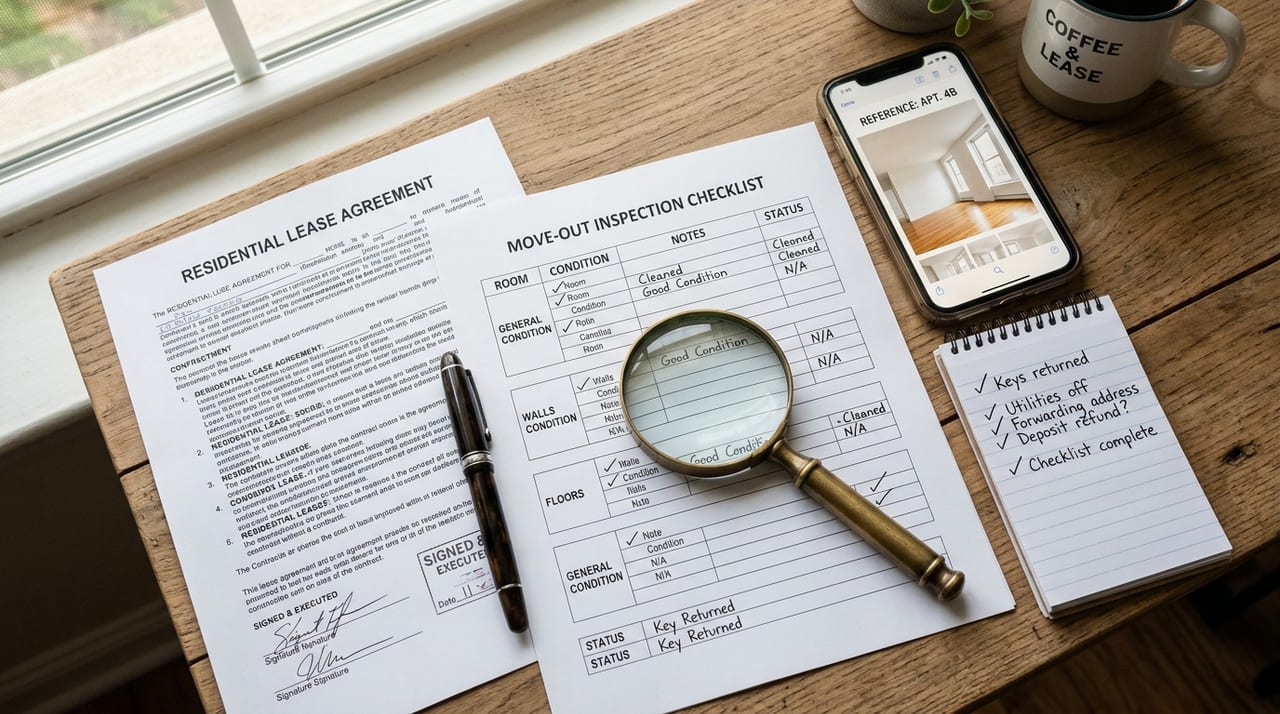
A security deposit held to cover repairs and cleaning when vacating. Typically 1-2 months' rent. After moving out, the remaining balance is returned after deducting costs for restoration to original condition.
Important Note: Cases where the entire amount is deducted at move-out may violate restoration guidelines. It is important to record details on the move-in checklist.
A uniquely Japanese business practice—an upfront payment given as gratitude to the landlord upon moving in. Typically 0-2 months' rent. Not refundable. In Kansai (Osaka, Kyoto, etc.), a format called "security money" is common, where the characteristics of security deposits and key money mix together.
A fee paid to a real estate brokerage company. The legal maximum is 1 month's rent plus consumption tax (10%). Some companies charge 0.5 months' rent or are free.
Prepayment of rent for the move-in month (or the following month). Typically the total of prorated rent from the move-in date plus one full month's rent for the following month.
A monthly fee contributed to the upkeep of shared building areas (elevators, hallways, exterior walls, etc.). Often shown separately from rent (e.g., 70,000 yen rent + 5,000 yen maintenance fee).
Used nearly interchangeably with maintenance fee, though technically it refers to the usage fee for shared facilities (trash areas, bicycle parking, etc.). Usually a few thousand yen per month.
Payment to a guarantor company (a firm that provides guarantees instead of a joint guarantor). Initial payment is typically 0.5-1 month's rent, with annual renewal fees of roughly 10,000-20,000 yen.
A person who assumes equal responsibility as the tenant in cases of rent default or contract violations. Typically a Japanese resident with guaranteed ability to pay is required; since this is difficult for foreigners to arrange, guarantor companies have become standard substitutes.
A company that provides rent guarantee in place of a joint guarantor. Major companies include GTN, Casa, Zenpo Ren, and New Stage. Some guarantee companies accommodate foreign tenants while others do not.
A typical rental contract that renews every 2 years. Without valid reason, landlords cannot unilaterally demand tenant departure (tenant protections are strong).
A contract that terminates at a predetermined period (usually 2-5 years). Continuation after the contract period ends requires renegotiation as a new agreement. Some cases have no key money and cheaper rent, but there is a risk that housing continuation after the period expires is not guaranteed.
An upfront payment made when renewing a standard lease at the 2-year mark. Typically 1 month's rent. In Kansai (Osaka, etc.), many properties have no renewal fee.
The process of extending the rental contract period (usually 2 years). May involve payment of renewal fees, guarantor company renewal fees, and purchasing new insurance.
The obligation to return a room to its pre-move-in condition when vacating. According to Ministry of Land, Infrastructure, Transport and Tourism guidelines, "dirt and damage from normal use are not the tenant's responsibility," but special clauses (discussed below) sometimes expand tenant liability.
Special provisions added to a contract. May include terms such as "Cleaning costs are the tenant's responsibility" or "Full replacement of wall coverings is the tenant's responsibility."
Written notice to the management company or landlord of intent to vacate, typically given 1-2 months before moving out. Check the notice period specified in your contract (usually 1-2 months prior).
Notation showing a room's composition (1K, 1DK, 1LDK, 2LDK, etc.). K = Kitchen, D = Dining, L = Living.
The size of the living space in square meters (㎡). Shared hallways and balconies are typically not included.
Electronic or card locks installed at the building entrance—a security system. Outside residents cannot enter without permission from building residents.
A search criterion many users include for security, privacy, and natural lighting reasons.
| Japanese | English |
|---|---|
| 敷金 | Security deposit |
| 礼金 | Key money |
| 仲介手数料 | Agency fee |
| 管理費 | Maintenance fee |
| 連帯保証人 | Joint guarantor |
| 保証会社 | Guarantor company |
| 普通借家契約 | Standard lease |
| 定期借家契約 | Fixed-term lease |
| 更新料 | Renewal fee |
| 原状回復 | Restoration to original condition |
| 特約 | Special clause |
| 解約予告 | Notice of termination |
不動産ネットワーク
投資物件・賃貸住宅・テナント・運営会社をつなぐ不動産4サイト連携。
A comprehensive breakdown of the differences between "security deposit," "key money," "guarantee money," and "non-refundable deductions" required in Japanese rental contracts, with a focus on regional customs in the Kanto and Kansai areas. Real estate professionals explain the legal nature, refund conditions, and move-out settlement rules for each term, providing clarity for foreign residents who often find these terms confusing.
床スラブ厚と上階の足音問題——賃貸で「ドン」という衝撃音が響く構造的な理由と物件選びのポイント
前橋・群馬の賃貸エリアガイド【2026年版】——主要エリア別家賃相場と住みやすさを徹底比較
Making the Most of Protruding Beams and Columns in Rental Apartments — Smart Furniture Placement Strategies
Mito & Ibaraki Rental Area Guide [2026] — Comprehensive Explanation of Rental Rates and Livability by Major Area
Uncovering Property Issues by Asking Previous Tenants About Their Departure—Questions to Ask During Viewings and How to Interpret Answers
