Want to move but lack the funds? This article explains concrete moving savings strategies and household budget review techniques to reach your target amount quickly.
Reviewed by: Nobuyuki MoriPresident, M-Assets Co., Ltd. / Licensed Real Estate Transaction Specialist (Miyagi #018212)
More people are planning moves around bonus payment months. Understand initial cost benchmarks, bonus timing mismatches, and double rent risks to make a smart financial plan.
Rental costs go far beyond monthly rent. This guide examines all the "hidden costs" of renting—from security deposits and key money to guarantor fees, maintenance fees, and move-out restoration costs.
Initial rental costs typically run 4–6 months of rent, but smart negotiation can significantly reduce this burden. This guide covers practical savings techniques: negotiating security deposits and key money, securing free rent, reducing agency fees, and leveraging off-season timing.
A clear explanation of the differences between security deposits, key money, and renewal fees in rental contracts. From cases where security deposits aren't returned to considerations for zero key money properties, renewal fee negotiation methods, and strategies to reduce overall initial costs—a real estate professional thoroughly addresses your questions about rental expenses.
Renting a residential property requires initial costs equivalent to 4–6 months of rent—security deposit, key money, and agency fee—all due at once. Thinking "I want to move now but don't have enough money" is not uncommon, and whether you have a deliberate savings plan significantly affects your move's timing and options. This article explains how to create a savings plan with moving as your goal.
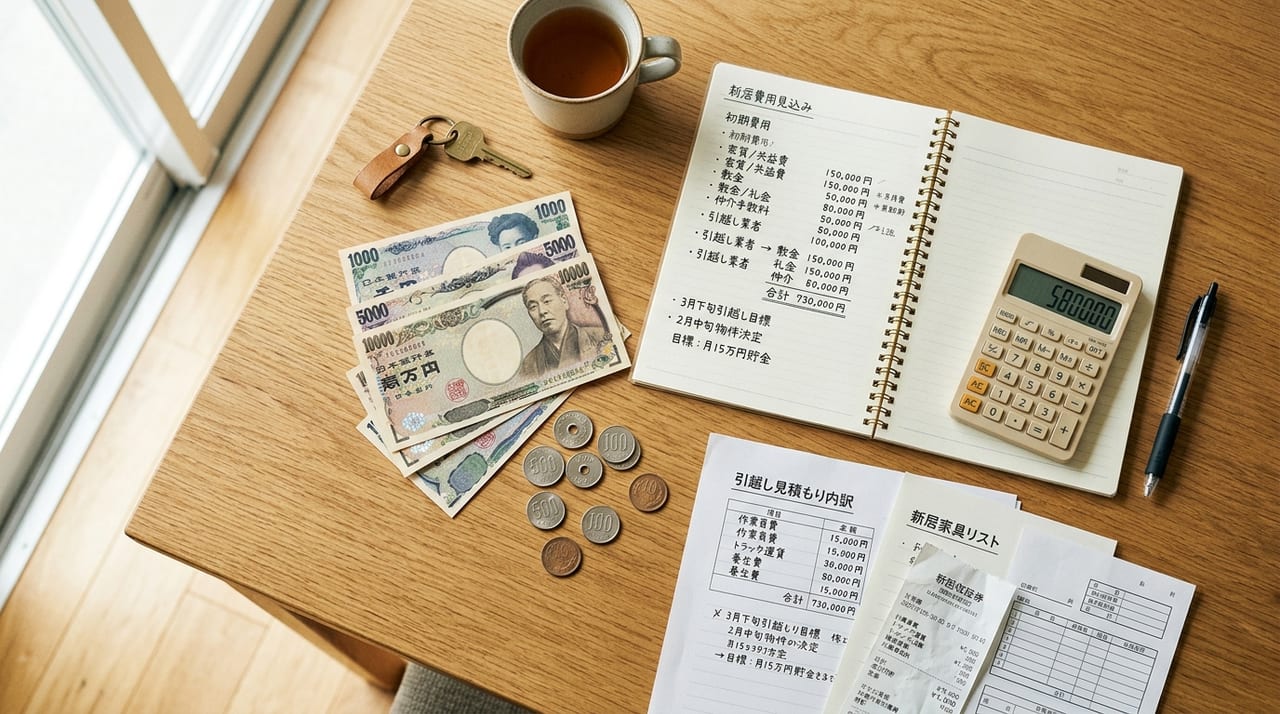
The first step in creating a savings plan is setting a target amount. Here's the breakdown of moving costs:
Initial Costs (Example: Apartment with ¥70,000 monthly rent)
Estimated total: ¥350,000–¥650,000
Additionally, furnishing a new home may require replacing furniture and appliances. Setting aside a buffer of ¥100,000–¥200,000 is recommended for peace of mind.
Once you've set your target amount and desired move date, you can calculate your monthly savings.
Example: Saving ¥500,000 in 1 year (12 months) → Monthly savings = ¥500,000 ÷ 12 months ≈ ¥42,000/month
Example: Saving ¥500,000 in 18 months → Monthly savings = ¥500,000 ÷ 18 months ≈ ¥28,000/month
Match this against your current monthly income and expenses, then set a savings amount you can sustain without strain. If your savings target is too high, it will squeeze your living expenses and increase the risk of abandoning the plan.
The secret to consistent moving savings is setting up automatic transfers to a dedicated savings account. If you leave money in your salary account and try to save what's left over at month's end, the target amount rarely materializes.
Recommended methods
If you have almost no surplus each month, review your current spending. Here are representative expense categories that can accelerate your moving savings.
Fixed cost review (major impact)
Variable expense management (consistency is key)
Reducing fixed costs by ¥10,000/month creates ¥120,000 in additional savings capacity annually. Use a budgeting app to visualize your progress and see the results in numbers.
If cutting costs alone feels too slow, consider earning more.
While building savings, also work on reducing the amount needed. A ¥50,000 reduction in target costs means moving that much sooner.
Even after starting to save, unexpected expenses or income fluctuations will inevitably cause some months to fall short. The biggest mistake is abandoning savings altogether. Here are three adjustments to consider in order:
Also, set a "checkpoint day" every 3 months to compare your savings balance against your goal. Catching and correcting gaps early is the key to reaching your target in the shortest time possible.
Moving savings can progress steadily through four steps: set target amount → calculate monthly savings → establish automatic transfer system → review fixed costs. The key to success is deciding your desired move date first, then working backward to determine your monthly savings amount. Rather than rushing into unsustainable cuts, building at a pace you can maintain long-term is the fastest path to moving with peace of mind.
Related Areas
床スラブ厚と上階の足音問題——賃貸で「ドン」という衝撃音が響く構造的な理由と物件選びのポイント
前橋・群馬の賃貸エリアガイド【2026年版】——主要エリア別家賃相場と住みやすさを徹底比較
Making the Most of Protruding Beams and Columns in Rental Apartments — Smart Furniture Placement Strategies
Mito & Ibaraki Rental Area Guide [2026] — Comprehensive Explanation of Rental Rates and Livability by Major Area
Uncovering Property Issues by Asking Previous Tenants About Their Departure—Questions to Ask During Viewings and How to Interpret Answers
