Finding a rental property for multi-generational living involves different considerations than a typical apartment search. This guide outlines the decision-making framework to ensure success in renting for multi-generational households—covering privacy, cost sharing, and future layout adjustments.
Reviewed by: Nobuyuki MoriPresident, M-Assets Co., Ltd. / Licensed Real Estate Transaction Specialist (Miyagi #018212)
Renting for "parent-child cohabitation"—where parents and children live in the same property. This guide covers everything from selecting floor plans and navigating tenant screening to managing cost-sharing—practical knowledge for harmonious living together.
When apartment hunting in Japan, you'll frequently encounter terms like "studio," "1K," and "1LDK." This guide explains the key differences and how to choose the right layout based on your lifestyle.
Clear explanation of the differences between "1K," "1DK," "1LDK," and "2DK," commonly seen in rental listings. Complete comparison of four floor plans by area, average rent, and best-suited household types.
For foreign nationals living in rental properties in Sendai: a practical guide to earthquake and flood preparedness, finding evacuation shelters, preparing emergency kits, coordinating with property management, and other disaster prevention measures you can start implementing today.
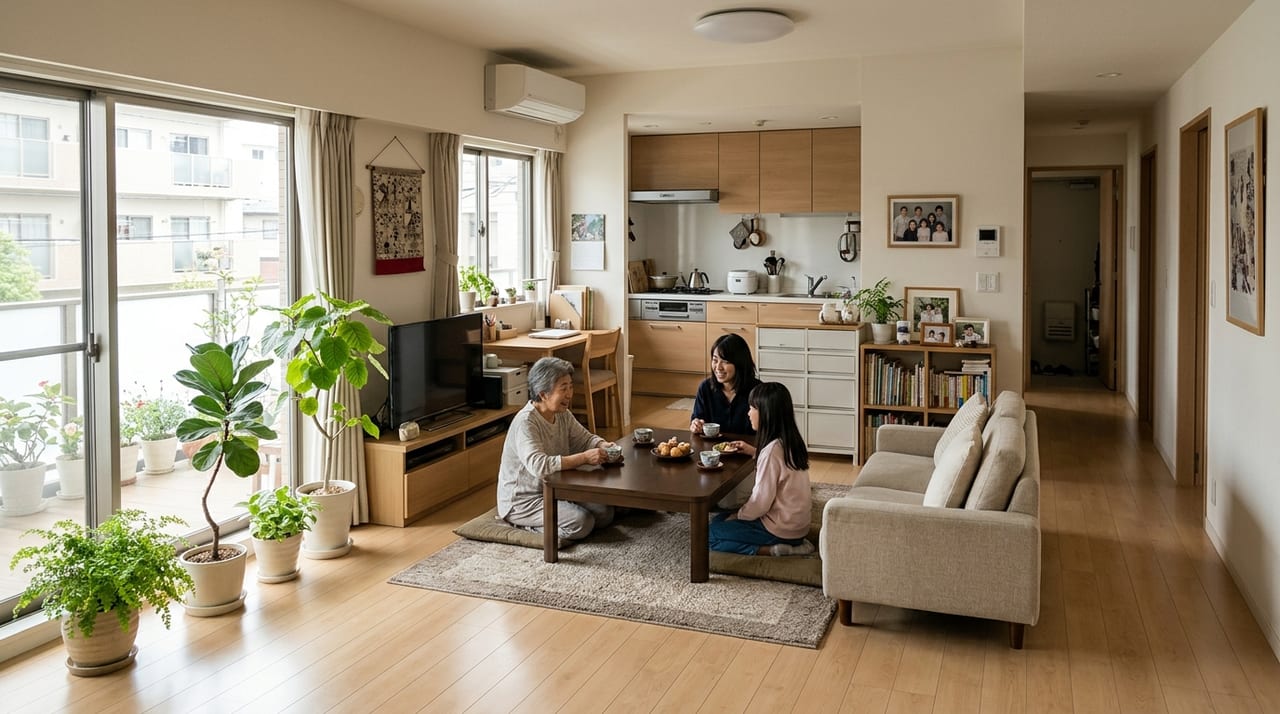
As Japan faces demographic aging, increasing care needs, and family relationship reconsiderations in the post-COVID era, more households are choosing to live together or nearby—combining parent and adult child generations. In the owner-occupied market, "two-generation homes" are designed specifically for this arrangement, but in the rental market, few properties explicitly target multi-generational living. Renters must carefully read the details of existing listings to find suitable properties.
Rental multi-generational living arrangements fall into three main types:
Each arrangement requires different considerations regarding layout, lease structure, and cost-sharing approaches.
When two generations live together as one unit, the required number of bedrooms is "the adult child generation's standard rooms plus a dedicated room for parents." If the adult child generation consists of a couple with one or two children, a 3-bedroom or 4-bedroom unit is standard.
The dedicated room for parents should be at least one separate room (6–8 tatami mats or roughly 18–22 square meters). If parents require care or may need it in the near future, the following conditions become important:
Single-family rentals and first-floor apartments in low-rise buildings typically meet these criteria best.
When both generations want to maintain their own privacy, split-level (two-story interior) units or two adjacent units in the same building rented separately—arranged side-by-side or vertically stacked—are options to consider.
Renting two adjacent units in the same building allows each generation to rent independently while maintaining complete lifestyle independence, yet allows easy access in emergencies. This arrangement requires both units to be managed by the same company with the same landlord, with the ideal layout being "neighboring units with adjacent entrances."
Single-family rentals offer the most flexibility for multi-generational living. A two-story, 4+ bedroom single-family rental makes it easy to divide the home vertically—parents on the first floor, adult children on the second. If each floor has its own toilet and small sink, near-independent living is possible. In apartment buildings, noise and different daily schedules often cause problems, but single-family homes minimize such concerns.
Standard rental contracts list one person (or joint guarantor) as the leaseholder. In multi-generational households, the adult child generation's primary earner typically signs the lease, with parents listed as co-occupants.
When parents are the primary income source or retired parents would sign independently, they may not meet screening criteria (monthly income, employment history). In such cases, the adult child generation can sign as the leaseholder with parents listed as co-occupants, making approval more likely.
Rental contracts require disclosure of "all household members who will live in the unit." This includes grandparents and their spouses—everyone actually living there must be listed on the application. If undisclosed co-occupants (like parents) are discovered after move-in, it may be considered a lease violation.
Legally, the lease signer bears full responsibility for rent payment. Even if the multi-generational household shares costs, the payment to the landlord and management company must go through a single lease signer, with cost-sharing arranged separately as a family agreement.
One of the biggest sources of tension in multi-generational rental households is unclear cost allocation. It's recommended to reach agreement on the following items in advance:
Monthly fixed costs:
Variable and emergency costs:
Keeping a cost-sharing document (even a LINE note works) prevents future disputes. Especially for rent, it's crucial to clarify upfront "who pays how much each month."
Multi-generational rental living often creates daily stress if the assumption is "we're family, so we share everything." Respecting each generation's privacy and autonomy through thoughtful rule-making is key to maintaining positive relationships.
Coordinating daily schedules:
Guests and privacy:
Caregiving and medical responsibilities:
Multi-generational rental living may require housing changes as circumstances evolve (children are born, parents' care needs increase, job transfers, divorce, etc.). To prepare:
Multi-generational living, when approached with careful property selection, clear cost-sharing, and thoughtful role division, brings many benefits: childcare support, elder care management, and household economy. Even in rental housing, living as a multi-generational family is realistic, and flexible planning tailored to family circumstances can make it work.
不動産ネットワーク
投資物件・賃貸住宅・テナント・運営会社をつなぐ不動産4サイト連携。
床スラブ厚と上階の足音問題——賃貸で「ドン」という衝撃音が響く構造的な理由と物件選びのポイント
前橋・群馬の賃貸エリアガイド【2026年版】——主要エリア別家賃相場と住みやすさを徹底比較
Making the Most of Protruding Beams and Columns in Rental Apartments — Smart Furniture Placement Strategies
Mito & Ibaraki Rental Area Guide [2026] — Comprehensive Explanation of Rental Rates and Livability by Major Area
Uncovering Property Issues by Asking Previous Tenants About Their Departure—Questions to Ask During Viewings and How to Interpret Answers
