1K vs 1DK vs 1LDK: A Comparison Guide | How to Read Floor Plans and Convert Between Tatami and Square Meters
Compare 1K, 1DK, and 1LDK apartment types at a glance. Learn what K/D/L/S symbols mean, how to convert between tatami and square meters, and how to choose the right floor plan for your lifestyle—whether you're single, a couple, or working from home in a Japanese rental.
In Japanese rental listings, you'll frequently see "1K," "1DK," and "1LDK"—symbols that represent apartment sizes and layouts by combining the number of private rooms with shared spaces (K/D/L). This article first compares 1K, 1DK, and 1LDK in a quick-reference table, then covers the basic rules for reading floor plans, how to convert between tatami and square meters, and how to choose the right layout for your lifestyle.
Most popular for working professionals living alone
1DK
35–45 ㎡
4.5–8 tatami mats
Singles with dining space, beginner couples
1LDK
40–55 ㎡
8+ tatami mats
Singles working from home, couples
2LDK
50–70 ㎡
8+ tatami mats
Married couples, families with small children
A quick rule of thumb: the number indicates the number of private rooms, and as you go from K to DK to LDK, the shared spaces get larger. This makes it easy to get a sense of any listing at first glance. Below, we explain what each symbol means in more detail.
When browsing Japanese rental listings, you'll see abbreviations like "1K," "1DK," "1LDK," and "2LDK." This notation system is unique to Japan and concisely describes how rooms are arranged. If you're a foreigner, it might seem confusing at first, but once you learn the basics, finding an apartment becomes much easier. In this article, we explain what each abbreviation means, the characteristics of each type, and how to choose a floor plan that matches your lifestyle.
How to Read Floor Plan Symbols
Japanese floor plan notation combines numbers and letters. The number indicates how many independent rooms (bedrooms) there are, while the letters indicate the types of shared spaces.
Here's what each letter means: K (Kitchen) refers to a cooking-only space, typically 4.5 tatami mats or smaller. D (Dining) is a space for eating and is combined with K as "DK." L (Living) is a living room or relaxation area and is combined as "LDK." S (Service Room) is a room with few windows that doesn't meet building code standards for natural light, so it's not counted as a bedroom; it's often used for storage or a study.
The number (1, 2, etc.) indicates how many independent rooms there are. 1 means one bedroom, 2 means two bedrooms. For example, "2LDK" means a floor plan with a living/dining/kitchen area plus two bedrooms.
Common Floor Plan Types and Space Guidelines
A studio apartment (WR) is the most compact type, with the kitchen and living space in one open room with no partition. Typically 15–25 ㎡, it's suited for first-time renters or those on a tight budget. However, since the entire living space is one room, good storage and organization are essential.
A 1K has an independent kitchen (up to 4.5 tatami mats) and one bedroom. Most are 25–35 ㎡, and the separation lets you keep cooking smells and daily activity separate from your bedroom. It's the most popular choice for people living alone.
A 1DK has a dining/kitchen area (4.5–8 tatami mats) and one bedroom, typically 35–45 ㎡. The separate dining space makes it good for singles who want a more spacious lifestyle, and also works well for couples.
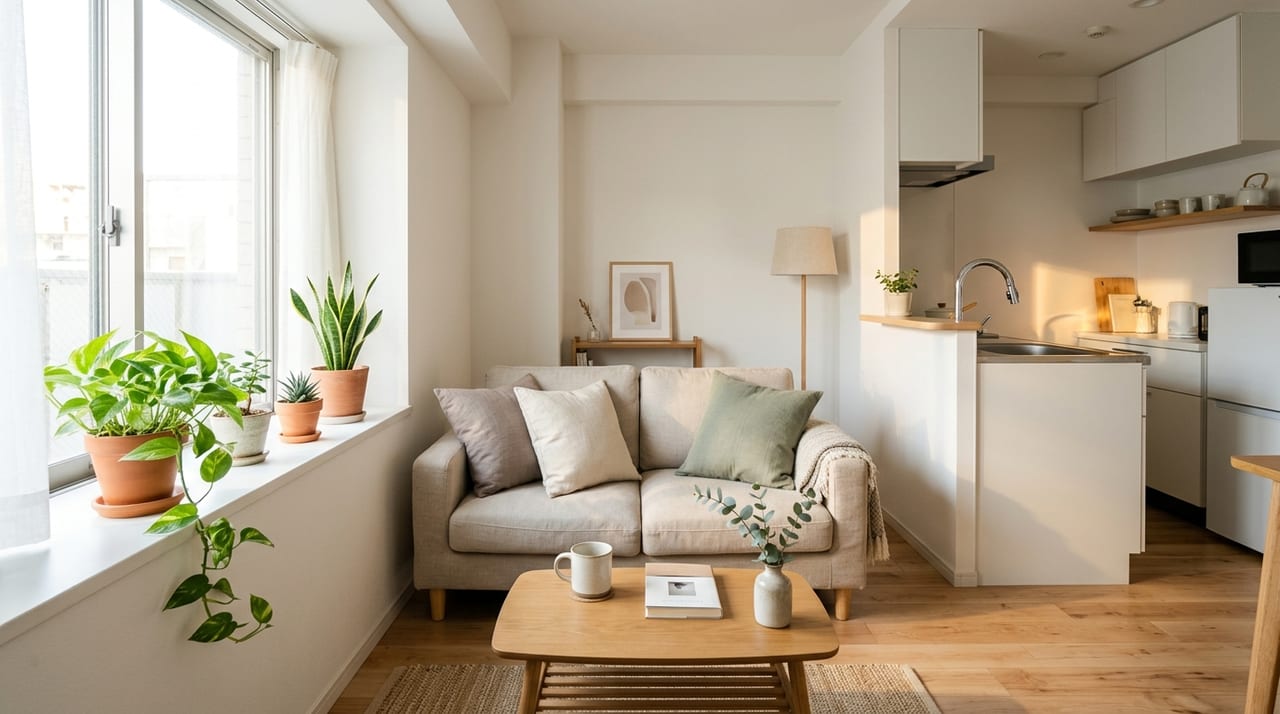
A 1LDK has a living/dining/kitchen area (8+ tatami mats) and one bedroom, typically 40–55 ㎡. It's popular with singles who need a work-from-home space and with couples.
A 2LDK has a living/dining/kitchen area and two bedrooms, typically 50–70 ㎡. It suits couples, married couples, and families with small children. The two bedrooms can be divided between a master bedroom and a work room, or used as children's bedrooms.
Converting Tatami Mats, Square Meters, and Tsubo
Japanese property listings use three different area units: tatami mats (畳), square meters (㎡), and tsubo. Understanding these makes it easier to compare properties.
One tatami mat is approximately 1.62–1.82 ㎡. The size varies depending on the region and era, so there's some variation. As a rough rule of thumb, remember 1 tatami ≈ 1.65 ㎡. One tsubo is approximately 3.31 ㎡ (2 tatami mats). For example, a 6-tatami room is roughly 10 ㎡. Combine the floor area shown in the listing with the floor plan to get a sense of the actual space.
Floor area can be measured two ways: "net floor area" (from the inside of the walls) and "architectural floor area" (from the center of the walls). Real estate listings typically use net floor area. Even with the same floor area in ㎡, the usable space differs depending on the layout and pillar placement, so it's important to experience the space in person during a viewing.
Choosing a Floor Plan Based on Your Lifestyle
If you're living alone and work from home frequently, we recommend a 1DK or larger—ideally a 1LDK—so you can separate your work space from your relaxation space. In a studio or 1K, it's hard to mentally switch between work and downtime, and your background for video calls can be awkward.
If you enjoy cooking and use the kitchen frequently, a 1DK or 1LDK with a larger kitchen suits you better. Since 1K kitchens are 4.5 tatami mats or smaller, they can feel cramped if you cook with others or have a lot of kitchen equipment.
For couples living together, a 1LDK or 2LDK works best. A 1LDK suits couples who want to spend time together in a spacious living room, while a 2LDK is better if you want separate rooms or if one person works from home.
If you entertain frequently or want a dedicated hobby room, we recommend a 2LDK or larger. With two bedrooms, you can use one as a guest room and the other for hobbies or extra storage.
Key Points to Check During a Viewing
Floor plans are only a guide. When viewing a property, also check natural light, air circulation, storage capacity, outlet placement, and internet connection availability.
Note that floor area typically doesn't include balconies or common hallways. Also, the building age and structure (wooden, steel, or reinforced concrete) significantly affect wall thickness, soundproofing, and insulation—even for the same floor plan. To choose a comfortable home, experience the space in person, not just on paper. Always check storage availability and type (closet vs. Japanese-style closet), as these directly affect daily living comfort.